
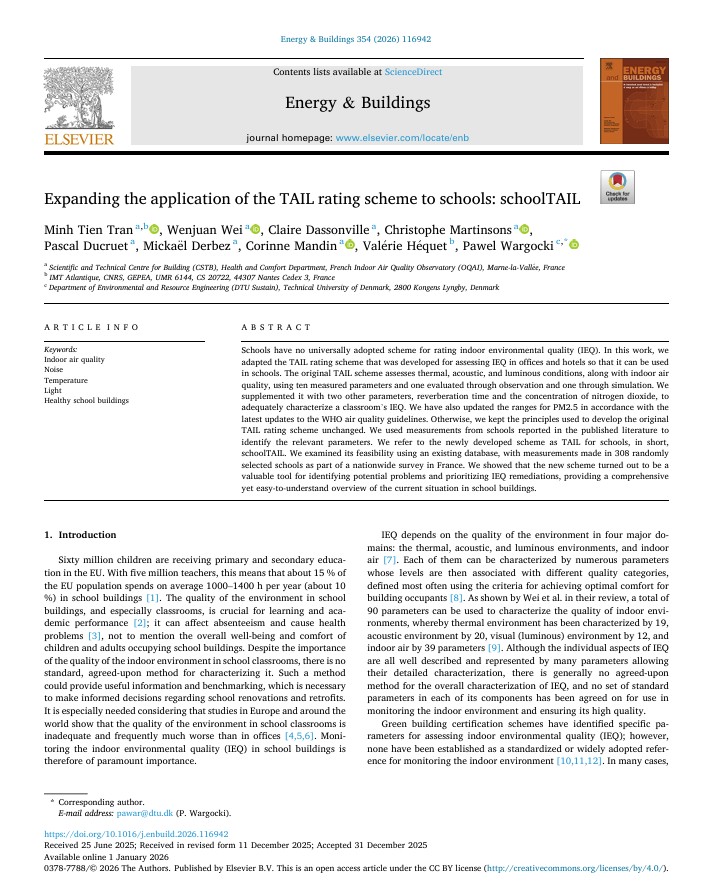
The study "Expanding the application of the TAIL rating scheme to schools: schoolTAIL" extends a practical framework for quantifying Indoor Environmental Quality (IEQ) to school buildings. The framework assesses key aspects of IEQ, including thermal comfort, indoor air quality, acoustics, lighting, and overall environmental quality.
"Unlike design-based metrics, TAIL measures actual IEQ performance, enabling benchmarking and comparisons similar to those found in energy certificates. It also identifies areas needing improvement and raises awareness among building occupants; these are key steps toward achieving high-quality indoor environments" (Pawel Wargocki, Technical University of Denmark).
This is the third paper in the TAIL series published in Energy and Buildings, following the original publication (link: TAIL, a new scheme for rating indoor environmental quality in offices and hotels undergoing deep energy renovation (EU ALDREN project) - ScienceDirect) and the development of the predicTAIL approach for use during the design phase (link: PredicTAIL, a prediction method for indoor environmental quality in buildings undergoing deep energy renovation based on the TAIL rating scheme - ScienceDirect)
Extending the application of the TAIL rating scheme to datasets from different countries and climate regions will enhance its applicability and provide insights for its future development. Within the BREEZE project, this contributes to ongoing efforts to improve the assessment and understanding of indoor environmental quality in buildings.

This project has received funding from the European Union’s LIFE Programme for the Environment and Climate Action under grant agreement No 101215197.
Co-funded by the European Union. Views and opinions expressed are however those of the author(s) only and do not necessarily reflect those of the European Union or CINEA. Neither the European Union nor the granting authority can be held responsible for them.